SAH.org
Friday, September 10, 2010
Search: 


SAH Board of Directors

Officers (also serve as Directors) 

Prof. Dianne Harris, President
harris3@illinois.edu
Dianne Harris is Director of the Illinois Program for Research in the Humanities.  Her publications include  the co-edited volume Villas and Gardens in Early Modern Italy and France (Cambridge University Press, 2001), and she is the author of The Nature of Authority: Villa Culture, Landscape, and Representation in Eighteenth-Century Lombardy (Pennsylvania State University Press, 2003) which won the Elisabeth Blair MacDougall Award from the Society of Architectural Historians in 2006.  She is also the author of Maybeck’s Landscapes: Drawing in Nature (William Stout Publisher, 2005). In addition to a co-edited volume (with D. Fairchild Ruggles) entitled Sites Unseen:  Landscape and Vision (University of Pittsburgh Press, 2007), Professor Harris served as guest-editor for a special issue of Landscape Journal devoted to the topic of “Race and Space,” that appeared in May of 2007.  She is currently writing a book that focuses on ordinary postwar houses and gardens in the United States between 1945-60, and she is serving as editor for a multidisciplinary volume on the Pennsylvania Levittown that will be published by the University of Pittsburgh Press.  Professor Harris is editor for the University of Pittsburgh Press’s new book series that focuses on politics, social justice and histories of the built environment. She is the recipient of a 2006 Iris Foundation Award for outstanding scholarly contributions in the history of art, decorative arts, and cultural history.

Dr. Abigail Van Slyck, 1st Vice President 
aavan@conncoll.edu
Abigail A. Van Slyck is the Dayton Professor of Art History at Connecticut College, where she directs the Architectural Studies program.  Her research interest is North American architecture of the nineteenth and twentieth centuries, with a particular focus on the relationship between commonplace social institutions and ideas about gender, race, class, and childhood.   She is the author of A Manufactured Wilderness: Summer Camps and the Shaping of American Youth, 1890-1960 (University of Minnesota Press, 2006) and Free to All: Carnegie Libraries and American Culture, 1890-1920 (University of Chicago Press, 1995).  In 2005, she served as guest curator at the Lyman Allyn Art Museum in New London, Connecticut, for Commerce and Culture: Architecture and Society on New London’s State Street, which won in 2006 a Wilbur Cross Award from the Connecticut Humanities Council and an Award of Merit from the Connecticut League of History Organizations.  A graduate of Smith College, she earned a Ph.D. in architecture at the University of California at Berkeley.  She is a past president of the Vernacular Architecture Forum and served as the JSAH book review editor (American topics) from 1996 to 2000.

Prof. Ken Breisch, 2nd Vice President


Prof. Gail Fenske, Secretary
ggf@msn.com
Gail Fenske is Professor of Architecture in the School of Architecture, Art & Historic Preservation at Roger Williams University, and has also taught at Wellesley and MIT. Her areas of interest as a teacher and scholar are modern European and American architecture. She is the author of The Skyscraper and the City: The Woolworth Building and the Making of Modern New York (University of Chicago Press, 2008), which received a New York City Book Award, and is currently preparing a co-edited book, Aalto and America for publication. She has published several chapters in books, most recently in The American Skyscraper: Cultural Histories (Cambridge University Press, 2005). Her research has been supported by grants and fellowships from the National Endowment for the Humanities, Smithsonian Institution, and the Graham Foundation. She received her Ph.D. in the History, Theory & Criticism of Architecture from MIT. She is a past president of the New England Chapter, Society of Architectural Historians.

Mr. Henry Kuehn, Treasurer
hhkuehn@worldnet.att.net
Following a career at Baxter, International, Henry Kuehn has spent the last 25 years as CEO of venture backed companies in the medical and healthcare industry.  He serves on several corporate boards and is an advisor to two venture capital firms.  He is a trustee of Saint Mary of the Woods College and serves on the national executive committee of the Yale Science and Engineering Association.  He is a life trustee of the Chicago Architecture Foundation and has served as a docent of that organization for the past 30 years.  He is a past president and trustee of the Graham Foundation for Advanced Studies in the Fine Arts.  Mr. Kuehn holds a B.E. in mechanical engineering (with high honors) from Yale University and received an MBA from Harvard Business School.


Directors
  

Prof. Daniel Abramson (until 2013) daniel.abramson@tufts.deu

Daniel M. Abramson is Associate Professor of Art History and Director of Architectural Studies at Tufts University, where he also Chairs the Department of Art and Art History.  His research interest is in the history of modern architecture; author of Building the Bank of England: Money, Architecture, Society, 1694-1942 (Yale University Press, 2005) and Skyscraper Rivals: The AIG Building and the Architecture of Wall Street (Princeton Architectural Press, 2001), as well as articles and essays in Critical Inquiry, Harvard Design Magazine, Architectural History, Praxis, and Journal of the Society of Architectural Historians.  His current book project on the idea of obsolescence in twentieth-century architecture and urbanism has received grant support from the American Council of Learned Societies, the National Endowment for the Humanities, the Paul Mellon Centre for Studies in British Art, and research centers at Harvard and Wellesley.  Abramson previously served the Society as JSAH book reviews editor for North and South American topics.


Dr. Nezar AlSayyad (until 2012)  nezar@berkeley.edu
Nezar AlSayyad is architect, planner, and urban historian. He is Professor of Architecture and Planning as well as Associate Dean for International Programs at the College of Environmental Design at the University of California, Berkeley. He is also Chair of the Center for Middle Eastern Studies at Berkeley as well as founder and President of the International Association for the Study of Traditional Environments (IASTE) and editor of Traditional Dwellings and Settlements Review (TDSR). As a scholar, he has authored and edited several books including Cinematic Urbanism (Routledge, 2007); Making Cairo Medieval (Lexington, 2005); The End of Tradition? (Routledge, 2004); Urban Informality (Lexington, 2004); Muslim Europe or Euro-Islam (Lexington, 2002); Hybrid Urbanism (Greenwood, 2001); Consuming Tradition /Manufacturing Heritage (Routledge, 2001); Forms and Dominance (Avebury, 1992); Cities and Caliphs (Greenwood, 1991); and Dwellings, Settlements and Tradition (University Press of America, 1989). He has also produced and directed two public television video documentaries: “Virtual Cairo” and “At Home with Mother Earth.” Among his numerous grants are those received from the U.S. Department of Education, NEA Design Arts Program, Getty Grant Program, and the Graham Foundation. Awards include the Beit AlQuran Medal, Bahrain; the Pioneer American Society Book Award; and the American Institute of Architects Education Honors. Professionally active as both an architect and planner, he is Principal of XXA-Office of Xross-Xultural Architecture.

Prof. Suzanne Blier (until 2012)
blier@fas.harvard.edu
Suzanne Preston Blier, the Allen Whitehill Clowes Professor of Fine Arts and of African and African American Studies at Harvard is a specialist in African art and architecture. She received her Ph.D. from Columbia University; Her books include: Butabu: Adobe Architecture in West Africa (2004), Art of the Senses: Masterpieces from the William and Bertha Teel Collection(Editor 2004), African Royal Art: The Majesty of Form (1998), African Vodun: Art, Psychology, and Power. (1995) and The Anatomy of Architecture: Ontology and Metaphor in Batammaliba Architectural Expression (1987). Four won awards. She is on the board of the Society of Architectural Historians. From 2005-2008 she was Chair of the Editorial Board of the Art Bulletin. Her fellowships include CASVA (the National Gallery), John Simon Guggenheim, the Radcliffe Institute, NEH, the Institute for Advanced Study, Princeton, Fulbright Senior Research, Social Science Research Council, ACLS, and  the Getty Center for the Study of Art. She is co-chair of the new open source multi-disciplinary GIS website, Africamap http://africamap.harvard.edu/icb/icb.do. From 1993-98 with a Seaver Foundation grant, she established an earlier Electronic Media Database titled, Baobab: Roots of Creativity in African Material Culture. Both projects explore African mapping in conjunction with ethnographic data, visual culture and history.

Ms. Wanda Bubriski (until 2013)

Mr. Wim deWit (until 2012)
WDeWit@getty.edu
Wim de Wit is the Head of the Department of Architecture and Design at the Getty Research Institute in Los Angeles.  He studied architectural history at the Catholic University in Nijmegen, The Netherlands.  After his graduation, he was appointed as a scholarly researcher responsible for the collections at the Netherlands Documentation Center for Architecture in Amsterdam (1974-1982).  Having moved to the United States in 1982, he first worked at the Cooper-Hewitt Museum in New York as a guest curator for an exhibition about the Amsterdam School, a group of Dutch architects of the early twentieth century.  From 1983 until 1993, he was the curator for architecture at the Chicago Historical Society, where he organized such exhibitions as “Louis Sullivan, the Function of Ornament” and “Grand Illusions: Chicago’s World’s Fair of 1893” and was the editor for the accompanying catalogs  He has been in Los Angeles since 1993.  He has organized a number of exhibitions at the Getty Research Institute, including “Shaping the Great City: Modern Architecture in Central Europe, 1890-1937” (2001), “Julius Shulman, Modernity and the Metropolis” (fall 2005), “Julius Shulman’s Los Angeles” at the Los Angeles Public Library (fall 2007), and “Lessons from Bernard Rudofsky” (GRI, March 11-June 8, 2008).  He was member of the board of the International Confederation of Architectural Museums (ICAM) between 1987 and 1994, as well as 1998 and 2002, and was this organization’s president from 1994-1998.  

Dr. Jesús Escobar (until 2012)
j-escobar@northwestern.edu
Jesús Escobar is Associate Professor in the Department of Art History at Northwestern University and a specialist in the art, architecture, and urbanism of early modern Spain, Italy, and the Spanish World.  He received his B.A. from Columbia University and Ph.D. from Princeton University.  In 2004-05, Escobar was a Fulbright U.S. Senior Research grantee to Spain and previously was a fellow of the Center for Advanced Study in the Visual Arts at the National Gallery of Art in Washington, D.C.  His book The Plaza Mayor and the Shaping of Baroque Madrid (Cambridge University Press, 2003; paper, 2009) won the Eleanor Tufts Award from the American Society for Hispanic Art Historical Studies and has been revised in a Spanish-language edition (Editorial Nerea, 2008).  He is currently at work on a new book project that examines seventeenth-century architecture and urbanism at the court of Philip IV in Madrid from a local and trans-Atlantic perspective.  Escobar also serves on the Editorial Board of caa.reviews, and is Editor for the scholarly book series, Buildings, Landscapes, and Societies, published by the Penn State Press.

Prof. Sarah Goldhagen (until 2013)  sarahwg@rcn.com

Sarah Williams Goldhagen is the architecture critic for the New Republic, and the founder and coeditor of Positions: On Modern Architecture + Urbanism/ Histories + Theories, published by the University of Minnesota Press. Before deciding to devote herself full-time to writing, Goldhagen taught for ten years at Harvard University’s Graduate School of Design, and she has also taught at Vassar and Wellesley Colleges, and at Columbia University and the University of Texas at Austin. The author of Louis Kahn’s Situated Modernism (Yale University Press) and co-editor of Anxious Modernisms: Experimentation in Postwar Architectural Culture (MIT Press), Goldhagen’s writings have appeared in numerous scholarly and general interest print and online publications, including the New York Times, American Prospect, Architectural Record, ArtNews, Art in America, Assemblage, Design Observer, Harvard Design Magazine, Journal of the Society of Architectural Historians, and the Chronicle of Higher Education. She is currently working on a book on architectural and urban experience for Harper/Collins.

Dorothy Metzger Habel (unitl 2011)
dhabel@utk.edu
Dorothy Metzger Habel is Professor of the History of Art and Director of the School of Art at the University of Tennessee, where she is also a Distinguished Professor in the Humanities. She received her B.A in the History of Art from Mount Holyoke College and M.A. and Ph.D. degrees from the University of Michigan. Her scholarship focuses on the architecture and urban development of Rome in the 17th century and has been supported by the Kress Foundation, the Graham Foundation for Advanced Studies in the Visual Arts and the National Endowment for the Humanities. She has published studies on the architecture and sculpture of Bernini, the architecture of Pietro da Cortona and the architectural history of Piazza S. Ignazio, Rome in the seventeenth and eighteenth centuries. Her most recent book, The Urban Development of Rome in the Age of Alexander VII (Cambridge) appeared in 2002. Currently, she is completing a book on the urban building process in baroque Rome.

Dr. Richard Hayes (until 2013) rhayes@aia.org

Dr. Richard L. Hayes is Director of Knowledge Resources for the American Insitute of Architects in Washington, DC where he develops, directs, and identifies emerging topics in the profession of architecture.  Recent projects include The Architect's Handbook of Professional Practice, Architectural Graphic Standards as well as overseeing the AIA's Practice Research Progams.  Hips past professional work experience includes being with the Center for Public Buildings of The Georgia Institute of Technology, on assignment to the Naval Facilities Engineering Command Headquarters serving as their Chief Historic Architect.  He has also be the Director of an Architecture Department for a private sector firm and a Research Architect for the Construction Engineering Research laboratory of Champaign, Illinois.  Dr. Hayes' professional registration includes architectural licences in Michigan, Wisconsin, Georgia and Virginia and a NCARB Certificate.  Georgia Tech awarded his Ph.D. focusing on architectural theory in 1995.  In 2005 he became a Certified Association Executive (CAE). 

Zeynep Kezer (until 2011)
Zeynep.Kezer@ncl.ac.uk  
Zeynep Kezer is a Lecturer in the School of Architecture Planning and Landscape at Newcastle University, UK. Previously she taught at the University of Nebraska-Lincoln and was a postdoctoral researcher at the University of British Columbia. She has received her B. Arch from Middle East Technical University in Ankara and her M Arch and Ph D from the University of California at Berkeley. She has been the recipient of grants from the Fulbright Commission, Killam Foundation, J Paul Getty Trust, and the British Academy grants. Her articles have appeared in Built Environment, Journal of Architectural Education, Perspectives in Vernacular Architecture, Deutsches Institut für Urbanistik Berichte, and various edited volumes. Her primary research interests include nationalism and modern state-building processes, and she is currently completing a manuscript entitled "Building the Nation-State: State, Space and Ideology in Early Republican Turkey." In addition to her work on the SAH Board, Dr Kezer serves as the editor of the Newsletter for the Society of Architectural Historians of Great Britain and as a UK correspondent for the newly established European Architectural History Network.

Prof. Alona Nitzan-Shiftan (until 2013)
alona@technion.ac.il 
Alona Nitzan-Shiftan is an assistant professor in the Faculty of Architecture and Town Planning at the Technion, Israel Institute of Technology.   She teaches the history and politics of architecture in cross cultural contexts with a focus on post-W.W.II architectural culture.  Her research focuses on the city of Jerusalem and on Israeli modernism, as well as on questions pertaining to historiography, cultural heritage, national identity and globalization.  Her work was sponsored by MIT, CASVA, the Getty/UCLA program, the Israel Science Foundation, and the Frankel Institute at the University of Michigan.  Her work on Erich Mendelsohn, post-’67 Jerusalem, historiography and heritage was published in journals such as Architectural History, Persepecta, TDSR and numerous edited volumes.  Her forthcoming book is tentatively titled Seizing Jerusalem: Architecture as Cultural Politics 1967-1977.

Dr. Ken Tadashi Oshima (until 2011)
koshima@u.washington.edu
 
Ken Tadashi Oshima is Associate Professor in the Department of Architecture at the University of Washington, where he teaches in the areas of trans-national architectural history, theory, representation, and design. He earned an A.B. degree, magna cum laude, in East Asian Studies and Visual & Environmental Studies from Harvard College, M. Arch. degree from U. C. Berkeley and Ph.D. in architectural history and theory from Columbia University. From 2003-5, he was a Robert and Lisa Sainsbury Fellow at the Sainsbury Institute for the Study of Japanese Arts and Cultures in London. Dr. Oshima's forthcoming publications include a monograph on Arata Isozaki (Phaidon, 2008) and Constructing Kokusai Kenchiku: International Architecture in Interwar Japan (U.W. Press, 2009). In 2006 and 2007, he led the Society of Architectural Historians Foreign Tour "Journey to Japan: Modernist Visions." He is an author for the Museum of Modern Art exhibition Home Delivery (2008), curator of the exhibition SANAA: Beyond Borders (Henry Art Gallery 2007-8), and co-curator of Crafting a Modern World: The Architecture and Design of Antonin and Noémi Raymond. An editor and contributor to Architecture + Urbanism for more than ten years, he co-authored the two-volume special issue, Visions of the Real: Modern Houses in the 20th Century (2000). His articles on the international context of architecture and urbanism in Japan have been published in The Journal of the Society of Architectural Historians, Architectural Theory Review, Kenchiku Bunka, Japan Architect, L'Architecture d'Aujourd'hui, and the AA Files.

Mr. Robert Rubin (until 2012) rrubin@dkrcapital.com

Bob Rubin is a  retired financier and doctoral candidate at Columbia who has curated a number of exhibitions around the work of Jean Prouvé.  He is co-author, with Olivier Cinqualbre, of Tropical House, published by Centre Pompidou Editions, and is curating the upcoming  “American Prayer” -- an exhibition based on the twentieth century book collection of Richard Prince -- at the Bibliotheque Nationale de France (opening March 28, 2011).  

Dr. Despina Stratigakos (until 2011)
dms58@buffalo.edu
Despina Stratigakos is Assistant Professor in the Department of Architecture at SUNY Buffalo, and previously taught at Harvard University and the University of Michigan.  She received her Ph.D. from Bryn Mawr College, her M.A. from the University of California, Berkeley, and her B.A. from the University of Toronto.  Her scholarship and activism focus on issues of diversity in architecture.  She is the author of A Women’s Berlin: Building the Modern City (University of Minnesota Press, 2008), which explores a largely forgotten metropolis created by women.  She has also published on the public image of women architects, the gender politics of the Werkbund, connections between architectural and sexual discourses in Weimar Germany, and exiled Jewish women architects in the United States, and recently curated an exhibition on Architect Barbie.  She is currently writing a book on the life and work of Gerdy Troost, Hitler’s trusted artistic advisor and one of the most powerful architects of the Third Reich.

Mr. Michael Waters (until 2011)
michael.waters1@nyu.edu
Michael Waters is a Ph.D. student at the Institute of Fine Arts at New York University studying architectural history. He is currently working on a dissertation on the use of spolia in Renaissance Italy and issues of materiality. Before to coming to New York, he received a B.F.A. in art history from the University of Illinois at Urbana-Champaign and a M.A. in architectural history from the University of Virginia. He has also studied at the Courtauld Institute in London. In addition to issues of reuse, his research interests include the application of computer technology in architectural history and Renaissance architectural prints and drawings. He is currently working on an article and exhibit on the production, transmission, and translation of sixteenth century architectural prints outside of treatises. He has presented papers at the SAH annual meeting as well as that of the Renaissance Society of America.


Ex Officio Members of the Board

Dr. Hilary Ballon, Founding Editor, JSAH Online
hmb3@columbia.edu 
As Editor of JSAH Hilary Ballon has launched a Mellon-funded project to plan for the online publication of the journal and to develop a new electronic interface with multimedia capabilities. Ballon's scholarship focuses on cities in two fields of research, 20th-century America and 17th-century Europe. She curated the three-part exhibition "Robert Moses and the Modern City"(2007), and her books include New York's Pennsylvania Stations; Louis Le Vau: Mazarin's Collège, Colbert's Revenge; and The Paris of Henri IV: Architecture and Urbanism, which won the SAH Alice Davis Hitchcock Prize. In September 2007 Ballon moved from Columbia University to NYU, where she is involved in creating a new NYU campus in the Middle East.

Prof. David B. Brownlee, Editor, JSAH 
dbrownle@sas.upenn.edu
Prof. David B. Brownlee is the Frances Shapiro-Weitzenhoffer Professor of the History of Art at the University of Pennsylvania. He is a historian of modern architecture whose interests embrace a wide range of subjects in Europe and America, from the late eighteenth century to the present. His recent books include Louis I. Kahn: In the Realm of Architecture (with David G. De Long,1991, translated into four other languages), Making a Modern Classic: The Architecture of the Philadelphia Museum of Art (1997), Building America's First University: An Historical and Architectural Guide to the University of Pennsylvania (with George Thomas, 2000) and Out of the Ordinary: Robert Venturi, Denise Scott Brown and Associates: Architecture, Urbanism, Design (with David De Long and Kathryn Hiesinger, 2001). Professor Brownlee has won numerous fellowships, and his work has earned three major publication prizes from the Society of Architectural Historians. He is a recipient of the University of Pennsylvania's Lindback Award for Distinguished Teaching.

Nathaniel Walker, Listserv Moderator 
Nathaniel_Walker@brown.edu 
Nathaniel R. Walker is a graduate student in the History of Art & Architecture Department at Brown University.  He received his BA in History from Belmont University in Nashville, Tennessee, and his MA in Architectural History from the Savannah College of Art and Design, where his Master's Thesis, entitled "Savannah's Lost Squares: The Fight Over Savannah's Town Plan and the Ascendance of Automobility," received the Outstanding Graduate Thesis Document Award in 2007.  Between his time in Savannah and his enrollment at Brown, Nathaniel worked very happily at Mitchell/Matthews Architects & Planners in Charlottesville, Virginia.  With his Ph.D. studies, Nathaniel is working to build upon and broaden the scope of a number of the questions he raised while exploring competing conceptions of "Modernity" in 1920s Savannah.  Specifically, he is interested in Utopian design and planning in the age of self-conscious "progress" and technological exhibitionism in art, literature, politics, and architecture.

Dr. Karen Kingsley, Editor-in-Chief, Buildings of the United States 
khkingsley@hotmail.com
Karen Kingsley is Editor-in-Chief of Buildings of the United States, professor emerita at the Tulane University's School of Architecture, and former Head of the Architectural Archive at Tulane. She is the author of Buildings of Louisiana (Oxford University Press, 2003) and the author of numerous articles for both scholarly and public interest books and journals.

M. Bridget Maley, Chapter Liason
bridget@argsf.com
Bridget Maley is a Senior Associate and Director of Planning at Architectural Resources Group (ARG) in San Francisco, California. As an undergraduate, Bridget studied History and Anthropology at Salem College in Winston-Salem, North Carolina. She earned her Master of Arts degree in Architectural History from the University of Virginia where her focus was early American Architecture. During her tenure at ARG, Bridget has managed planning and architectural documentation projects throughout California and the West, including work in Hawaii, Arizona, Oregon, and Alaska. Her work on the Historic Downtown Los Angeles Design Guidelines has won numerous awards.  San Francisco Mayor Gavin Newsom appointed Bridget to the city’s Landmarks Preservation Advisory Board in May 2004.  From 2001 – 2004, Bridget served as President of the Northern California Chapter of the Society of Architectural Historians.

David Fixler, Preservation Officer
dfixler@eypae.com 
David Fixler is a Principal at Einhorn Yaffee Prescott Architecture & Engineering, PC in Boston specializing in preservation and adaptive re-use, with particular emphasis on the work of the Modern movement.  A graduate of Tufts and Columbia Universities, his projects include the renovation of Alvar Aalto’s Baker House at MIT, and work for numerous American colleges, universities and cultural institutions, state and federal government, and the United Nations.  A frequent teacher, writer and lecturer on architectural history, preservation and design, David has had his work published internationally and has helped to organize numerous conferences on a wide range of architecture and preservation topics.  He is active in a variety of professional organizations, including serving as a Director of the Society of Architectural Historians, United States Representative on the DOCOMOMO International Specialty Committee for Registers (ISCR), and as the president of DOCOMOMO-US/New England.

Pauline Saliga, Executive Director
psaliga@sah.org
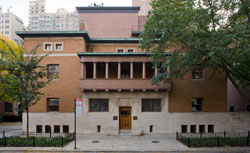
Pauline Saliga joined SAH as Executive Director in 1995, just as the Society was preparing to move its national headquarters from Philadelphia to the Charnley-Persky House in Chicago .  Saliga , who holds a Master’s degree in art history and museum administration from the University of Michigan , was Associate Curator of Architecture at The Art Institute of Chicago from 1981 to 1995.  While at the Art Institute, Ms. Saliga organized numerous exhibitions and catalogues focusing on 19th and 20th century architecture in America and Europe, including Fragments of Chicago’s Past; Building in a New Spain; Contemporary Spanish Architecture; and Design for the Continuous Present: The Architecture of Bruce Goff, 1904-1982.  Ms. Saliga’s other publications include The Sky’s the Limit: A Century of Chicago Skyscrapers and many museum catalogues that she oversaw when she was a curator at the Museum of Contemporary Art in Chicago from 1977 to 1981.  Currently, Saliga is researching the history of Japanese garden design in North America , and she has an avid interest in the history of industrial design.

Dr. Nezar AlSayyad, Chair, Investment Committee
nezar@berkeley.edu


Quick Links


eNews Sign up

Quick Poll

Has your department lost tenure track positions in the past five years?
Yes.
No.
We have a hold on filling TT positions.
We have created new TT positions.
My institution does not have TT positions.


Home | Contact Us