Railway Exchange Building

Society of Architectural Historians--Buildings of the United States


   Railway Exchange Building, 1903-04

   Now Santa Fe Center

   80 East Jackson Boulevard

   D.H. Burnham and Co.

   Restoration: Frye Gillan and Molinaro, 1982-85


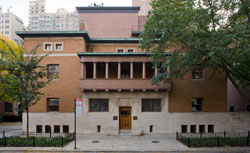
Although most visitors enter the former Railway Exchange Building from Michigan Avenue, the formal entrance is on Jackson Boulevard.  When D.H. Burnham and Co. designed this center for the thriving railroad industry in the early part of the century, South Michigan Avenue, now a great boulevard, was narrow and brick-paved.  Despite the presence of The Art Institute of Chicago (1892-93) across the street, such amenities as Grant Park did not yet exist.  Therefore, an impressive entrance to an impressive building, a feature Burnham must have required, was better made from Jackson than Michigan.  Burnham’s firm not only designed the seventeen-story office block, Burnham himself was the building’s major stockholder, and moved the firm’s offices onto the fourteenth floor.  His descendants maintained an interest in the office block until 1952.


The building’s organization is the classicization of the design of the Rookery (1885-88) and thus reflects the influence of John Wellborn Root, the firm’s chief designer from 1873 to 1891, and of his successor, Charles B. Atwood, who filled that role from 1891 to 1895.  As in Root’s designs for the Rookery, a two-story enclosed court was built at the street level of the Railway Exchange, and above it an open light well was surrounded by a ring of offices.  Although the Rookery’s court recalled an airy birdcage, its Railway Exchange counterpart was square and followed a symmetrical, Beaux-Arts plan, echoing Atwood’s design for the massive Ellicott Square Building in Buffalo (1893-94).  On a direct axis across the court from the Railway Exchange’s high, arched entrance, centered on the Jackson Boulevard façade, an imperial staircase led to the second-floor balcony and shops.


D.H. Burnham and Co.’s designer for the Railway Exchange was Frederick P. Dinkelberg (c.1869-1935), who had joined the firm as an assistant to Atwood.  Designer for Burnham of the famed Flatiron Building in New York (1902) and later of the Conway Building in Chicago (1912-13), Dinkelberg would in later years be associated with the firm of Thielbar and Fugard on the Jewelers Building (1924-26).  As in 1895 Atwood had used white-glazed terra-cotta as exterior sheathing of the Reliance Building, so it was used by Dinkelberg on the Exchange’s exterior façade and interior court.  The designs for the ornamental dentils, balusters, column capitals, and other details were classical in origin.  To brighten the inner offices, the light well was lined with white-glazed brick, as Root had done in the Rookery.  And like the Reliance Building, the Railway Exchange is completely steel-framed, but its classical detailing makes no effort to exploit the appearance of skeletal construction.


The contemporary owner of the building is the Santa Fe Southern Pacific Corporation.  The Santa Fe Railroad (originally the Atchinson, Topeka and Santa Fe) had been tenant of the building from its opening, so when the diversified transportation company made Chicago its headquarters in 1982, it elected to restore the Railway Exchange Building rather than build or lease in another location.  The building was listed in the National Register of Historic Places in June 1982, and a painstaking restoration took place under the terms of the National Historic Preservation Act.  The most dramatic result was the newly revealed interior court:  the tarred-over skylight was replaced, and the light well above it was capped with translucent, insulating glass to create a fifteen-story atrium.  Open corridors were constructed around the atrium to provide interior circulation on every floor.


Although the original proposal to turn the light well into an atrium was made by the firm of Murphy/Jahn, the commission to supervise its restoration and renovation was given to Metz, Train and Youngren.  Lonn Frye, of the firm Frye Gillan and Molinaro, was the designer in charge.  Instead of removing the glass from the lower skylight, as Murphy/Jahn had proposed, Frye restored it, adding a stenciled Pompeian decoration from an early D.H. Burnham and Co. design (never executed).  The original marquee of lights was reinstalled around the court.  An early design for a marble floor with a five-color border (also previously unexecuted) was followed in the lobby.  “A restoration better than the original” was the proud assessment of the project by both architects and client.  The ground-floor storefront notably is home to the Chicago Architecture Foundation, a local non-profit focusing on educating the public on Chicago’s building history through tours, lectures, and other programs.  The ground-floor lobby is open to the public and is often used by the Foundation as an exhibition space.


As in both the Rookery and the Ellicott Square Building, retail stores originally surrounded the court on both levels of the Railway Exchange, with the mezzanine considered the more desirable location.  An early tenant was the Northwestern Terra Cotta Company (supplier of the white-glazed terra-cotta on the exterior), which displayed examples of its molds for architectural details on the mezzanine balcony.  During the restoration of the building in the 1980s, actual terra-cotta was used on the exterior where replacements were necessary, but a synthetic tile, microcotta, was chosen for the interior.  Furthermore, the original mahogany on the storefronts was refinished, and bronze framing was uniformly installed.  Although the building is air-conditioned, the windows on the office floors actually open and shut.


The Railway Exchange is significant not only as an architectural landmark but also a historic site: it was here that Daniel Burnham and a staff of assistants drew up the Plan of Chicago, published in 1909.  A small penthouse on the northeast corner of the rooftop was the Plan office, and it was retained by the restoration architects.  From its windows, Burnham could survey the bleak landscape surrounding The Art Institute of Chicago and dream of a future lakefront park, one of the keystones of the Plan.  He could also observe the progress of his own efforts to improve Michigan Avenue: the construction of the adjacent Orchestra Hall (1905), at 218 South Michigan, and the Peoples Gas Company Building (1910-11), another classically inspired skyscraper, three stories taller than the Exchange, at 122 South Michigan Avenue.

Reprinted with permission from Jane H. Clarke, Pauline A. Saliga and John Zukowsky, authors of The Sky’s the Limit:  A Century of Chicago Skyscrapers, New York:  Rizzoli International, 1990.  Text © 1990 by Jane H. Clarke, Pauline A. Saliga and John Zukowsky, all rights reserved.  Updates by John Cramer © 2010 by Society of Architectural Historians, all rights reserved.  Photo:  © 2009 John Gronkowski Photography, all rights reserved.

Return to list of buildings on tour